

Slideshow
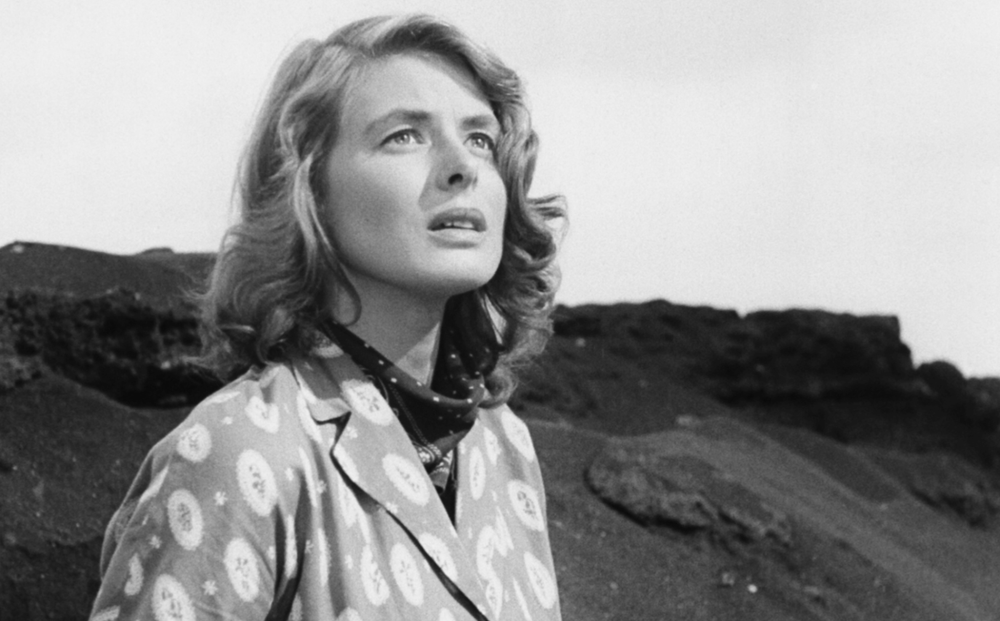
STROMBOLI
Monday, November 30
8:00 – 35mm
Friday, December 4
8:10 – 35mm
Saturday, December 5
12:20 – 35mm
Thursday, December 10
4:50 – 35mm
Italy/U.S., 1950
Directed by Roberto Rossellini
Starring Ingrid Bergman, Mario Vitale, Renzo Cesana, Mario Sponzo
Approx. 106 min. 35mm.
Upon seeing PAISAN in 1948, Ingrid Bergman sent Roberto Rossellini a fan letter, offering her services on any project he might want to make. “Well, who is this Ingrid Bergman?” asked Rossellini, unfamiliar with her work. Duly schooled and armed with a promissory note from Hollywood’s most popular actress, Rossellini went calling in California. After failing to come to terms with Samuel Goldwyn and David O. Selznick, Rossellini and Bergman signed a contract with Howard Hughes, the new owner of RKO Radio Pictures, who luckily had no need of reading a script beforehand. Bergman and Rossellini sailed for Stromboli, a remote island that would be the setting for their first picture together. Bergman plays Karin, a Lithuanian refugee whose only hope of getting out of a displaced persons camp after the war is to marry Antonio (Mario Vitale), a simple fisherman. Returning to his modest home on Stromboli, the couple faces one crisis after another: he is too poor to give her the life to which she’s accustomed, she is ostracized by the villagers for a lack of modesty. Nature asserts its supremacy, as volcanoes are wont to do. (Even Antonio’s “gift” of a pet ferret is a cruel reminder of the local food chain.) STROMBOLI becomes a vision quest, a groping towards cosmic grace that reveals a new vulnerability in Bergman that Hollywood never dared tap. Back on terra firma, Rossellini’s rangy artistry was quickly overshadowed by the revelation that he had begun an affair with Bergman and impregnated her. “Probably no film in history has received as much publicity as STROMBOLI,” noted Variety, but leering curiosity did not translate into ticket sales for this intuitively-constructed art film.
35mm print courtesy Cinecittà.
Reviews
“Bergman’s solitude is at the heart of STROMBOLI… Vainly she veers, without apparent progress; yet, without knowing it she is advancing, through the attrition of boredom and of time.”
– Jacques Rivette
“The brazen originality of STROMBOLI... is hard to detect, because the tone [it strikes] is one that has become a dominant mode of modern filmmaking. Rossellini turned the dramas of Bergman’s life into her art, and, in the process, presented her on-screen not as a character or even as an actor but as herself.”
– Richard Brody, The New Yorker
“STROMBOLI’s portrayal of marriage is trailblazing in that it drops any flicker of high-strung romantic drama to show the institution as a series of negotiations over agency and power. In that, Rossellini set the tone not just for his next two films with Bergman but for all modernist cinematic forays into the intimate universe of spousal anxieties for the next two decades.”
– Dina Iordanova, The Criterion Collection